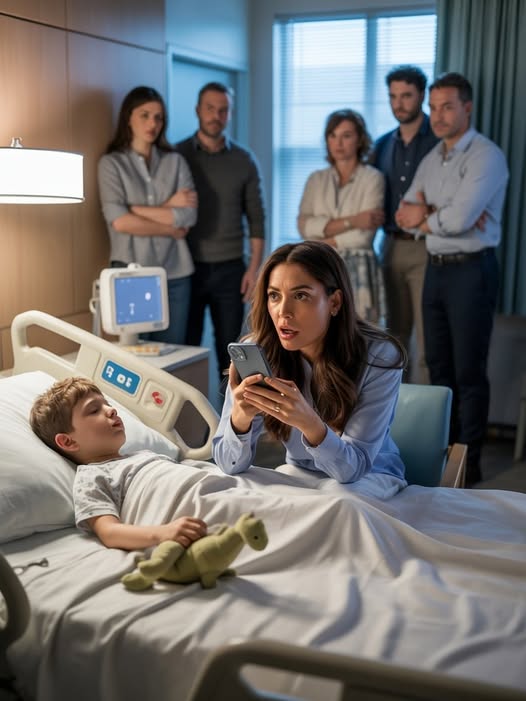
He woke up with a zipper down his chest and an empty room where a village should have been, and in that sterile absence I finally saw the price tag hanging off every “I’ve got you” I’d ever offered. The monitors counted his heartbeats while my own history of overdrafts and IOUs replayed like a malpractice reel, each sacrifice a receipt no one intended to honor. I’d mistaken being needed for being loved, emergencies for intimacy, wiring myself into other people’s storms until there was nothing left for the boy under the fluorescent glare. By the time the surgeon said “He made it,” my phone was a silent indictment, a scroll of unanswered pleas and ghosted calls, and the word “help” tasted like met…

The unraveling didn’t announce itself with fireworks; it arrived as a thousand small humiliations—the declined card at the pharmacy, the voicemail from the bank, the way my son’s shoulders tensed every time my ringtone broke the quiet. “Can you just help this once?” came with crying emojis and photos of eviction notices, but beneath the theater was a steady belief that my veins were an ATM. I’d signed my name under other people’s risks, skipped checkups because someone else’s crisis felt more urgent, sat in parking lots wiring bail money while my son slept alone. When his small fingers threaded through mine in the ICU, the math finally balanced: I was underwriting everyone’s survival but his. Saying “no” felt like setting off explosives in a house I’d built myself. Canceling cards made my hands shake; blocking numbers felt like erasing history. Their responses arrived in paragraphs—how I’d “changed,” how after “everything they’d done for me” I could be so heartless—each message a guilt-dipped hook. But as I read, something inside me went still. Their love had always been a contract with hidden fees, and I was done paying in blo… The smear campaign was immediate and efficient.
Screenshots of my boundaries made their rounds in group chats I was no longer in, my silence translated into character flaws by people who’d never once sat in that plastic chair outside an operating room. I became the villain in a story I’d once funded, cast as “selfish” for finally choosing the boy with the stitched-up chest over cousins who only called when something was on fire. I let the accusations pile up like unopened bills while I memorized medication schedules, learned how to tape gauze without tugging at tender skin, and rediscovered what my own laugh sounded like when it wasn’t sandwiched between someone else’s disasters. Our evenings shrank to the radius of our chipped kitchen table and the soft beep of the baby monitor I refused to unplug, even though he wasn’t a baby anymore.
One night, under the hum of the fridge and a single dim bulb, my son slid a drawing toward me: two stick figures, both with bold, uneven lines down their chests. “It’s us,” he said. “We both got fixed.” His certainty cracked something open. I hadn’t abandoned my family; I’d finally recognized who my family was. The scar on his chest became a border I would not let anyone cross with demands disguised as love. I stopped auditioning for a role in other people’s lives and started inhabiting my own. The quiet that followed wasn’t loneliness; it was recovery. Without the constant buzz of incoming crises, I could hear the softer sounds—pencil on paper, his steady breathing from the next room, my own heartbeat no longer racing toward the next emergency. Love, I learned, isn’t the drama that erupts when you say no; it’s the presence that remains when you have nothing left to give but yourself. In that small, ordinary life—mismatched plates, overdue laundry, shared scars—I finally felt chosen, not charged. The subscription had ended; the home, at last, did not require me to bleed to be believ.